GEO vs SEO vs AEO: What's the Difference and Which One Matters?
GEO vs SEO vs AEO explained with a side-by-side table: goals, signals, metrics, tools and timelines, plus what to do first and how to combine all three.
Key takeaways
- SEO earns rankings and clicks in search results, AEO earns the single direct answer, and GEO earns a mention or citation inside AI-written responses.
- The three overlap heavily: crawlable pages, clear answers and trusted sources help all of them, so you build one foundation, not three programs.
- SEO is measured in rankings and clicks, while GEO and AEO are measured in visibility, citations, sentiment and position inside answers.
- Do SEO fundamentals first, restructure key pages answer-first for AEO, then measure and expand GEO across engines and off-site sources.
- GEO does not replace SEO; it adds a second layer of measurement and off-site work on top of it.
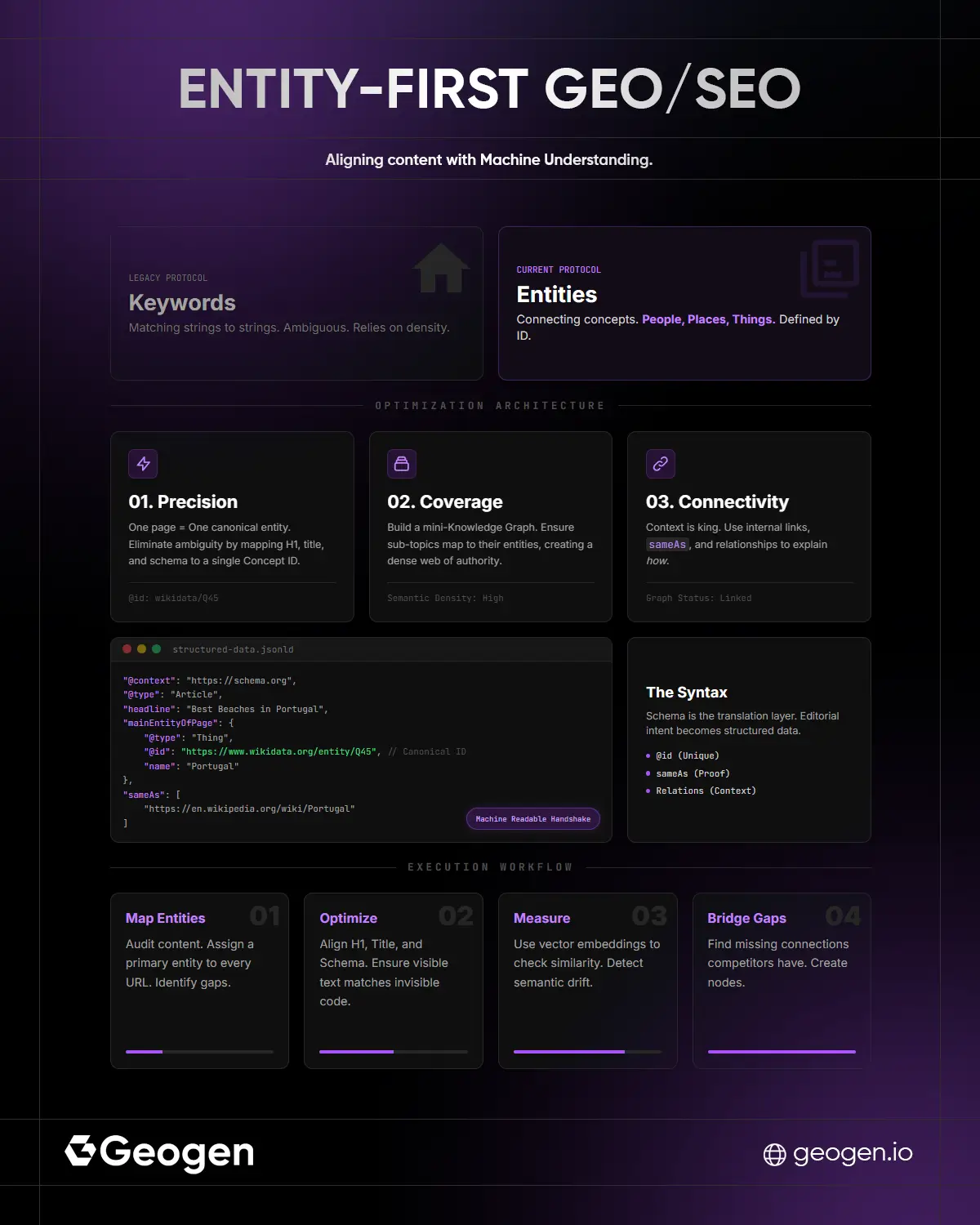
SEO gets your pages ranked in search results, AEO makes a page the direct answer to a question, and GEO gets your brand mentioned and cited inside answers that AI engines write. They share most of their foundations, so you do not choose one. You build the SEO base, shape key pages for AEO, and use GEO to measure and win visibility in ChatGPT, Gemini, Perplexity and Google’s AI features.
The terms are used loosely, and different vendors draw the lines differently. This page gives one consistent set of definitions, a side-by-side table, and a practical order of operations.
What is the difference between GEO, SEO and AEO?
Here is the comparison in one table.
| Dimension | SEO | AEO | GEO |
|---|---|---|---|
| Full name | Search engine optimization | Answer engine optimization | Generative engine optimization |
| Goal | Rank pages and win the click | Be the direct, extractable answer | Be mentioned and cited in AI-written answers |
| Where results appear | Search results pages (blue links, snippets, local packs) | Featured snippets, voice answers, answer boxes, AI answers | ChatGPT, Gemini, Perplexity, Google AI Overviews and AI Mode, Microsoft Copilot, Claude and others |
| Main signals | Relevance, links, page experience, crawlability, topical authority | Concise answers, clear definitions, lists and tables, structured data, question-shaped headings | Brand mentions on trusted third-party sources, citable facts and original data, entity clarity, sentiment, retrievability |
| Unit of success | A ranking position and a visit | Being the answer shown | A mention, a citation, a recommendation |
| Key metrics | Rankings, impressions, clicks, organic sessions, conversions | Snippet ownership, answer inclusion, voice and zero-click presence | Visibility (share of answers that mention you), citations, average position in the answer, sentiment, share of voice vs competitors |
| Typical tools | Google Search Console, rank trackers, crawlers, backlink tools | Search Console, SERP-feature trackers, schema validators | AI visibility platforms that run prompts across engines and record every answer |
| Timeline | Builds over months as pages are indexed and earn links | Can move once a page is re-crawled and restructured | Answers vary day to day, so progress shows up in repeated measurement; no guaranteed timeline |
| Who owns it | SEO and content teams | Content and SEO teams | SEO, content, PR and brand teams together |
Two points the table cannot show. First, the goal differs more than the work: much of the underlying work is the same. Second, the click is no longer guaranteed. A Pew Research Center analysis of 900 U.S. adults found people clicked a traditional result in 8% of visits when a Google AI summary appeared versus 15% when it did not. That is why visibility inside the answer is now its own goal.
What is SEO?
SEO is the practice of making web pages easy for search engines to crawl, understand and rank so that people find them through search results. It rests on relevance to the query, authority (mainly links and reputation), content quality and page experience. Its output is a ranked list, and its reward is a visit.
SEO remains the base layer. AI engines that retrieve live web content depend on pages being accessible and indexed, and Google states that AI Overviews and AI Mode need no special optimization beyond standard SEO best practices.
What is AEO?
AEO is the practice of structuring content so a search or answer system can extract it as the direct answer to a question. The target can be a featured snippet, a voice assistant reply, an answer box or an AI-written answer. The techniques are mostly editorial: put the answer in the first one or two sentences, write headings as the questions people ask, use lists and tables, define terms in one line, and mark up FAQs accurately.
AEO is the nearest cousin of SEO. If you want the detail, see our guide to what answer engine optimization is and the answer-first content strategy.
What is GEO?
GEO is the practice of increasing how often, and how favorably, generative AI engines mention and cite your brand and content in the answers they compose. The term was formalized in the research paper GEO: Generative Engine Optimization (Aggarwal et al., accepted to KDD 2024), which reported that certain content changes can boost visibility in generative engine responses by up to 40% on its benchmark. Treat that as evidence the levers are real, not a promise for your site.
What separates GEO from the other two is where the signal lives. An AI engine often runs several searches while answering (query fan-out), pulls from many sources, and writes its own summary. Your brand can be recommended because Reddit threads, review sites and publications describe it well, even when your own page does not rank first. The full method is in our ultimate guide to generative engine optimization.
Where do GEO, SEO and AEO overlap?
Most of the work is shared. A useful way to see it:
- Shared by all three: crawlable, fast, accurate pages; clear topical focus; original information; named authors and sources; consistent brand and entity details.
- Shared by AEO and GEO: answer-first writing, definitions, comparison tables, FAQs, statistics with named sources.
- Mostly GEO: earning mentions on third-party sites that AI engines cite, tracking what each engine says about you, correcting wrong or outdated descriptions, and watching competitors in the same answers.
- Mostly SEO: keyword targeting by volume, link acquisition for ranking, technical rankings factors such as internal linking depth and site architecture.
Evidence that off-site brand signals matter for AI visibility comes from an Ahrefs study of 75,000 brands, where branded web mentions had a 0.664 Spearman correlation with appearing in Google AI Overviews, against 0.218 for backlinks. Correlation is not causation, but it supports putting reputation work next to link work.
Is GEO replacing SEO?
No. GEO sits on top of SEO rather than in place of it, because AI engines still need crawlable, trustworthy pages to retrieve and cite, and classic search still sends traffic. What changes is measurement: rankings alone no longer tell you whether people see your brand. We cover that verdict in is GEO replacing SEO.
Which should you do first?
Use this order. Each step makes the next one cheaper.
- Fix the SEO base on your money pages. Make sure they are indexable, load quickly, are linked internally, and state facts accurately. Check that robots.txt does not block the AI crawlers you want, for example OpenAI’s OAI-SearchBot, which controls appearance in ChatGPT search, is separate from GPTBot, which relates to training.
- Rewrite your top pages answer-first (AEO). Put the direct answer in the opening 40 to 70 words, turn H2s into questions, add a table where a comparison exists, and add FAQs.
- Measure your AI visibility (GEO). Pick 20 to 50 prompts your buyers actually ask. Run them across several engines on a schedule and record whether you are mentioned, how you are described, in what position, and which sources are cited. GeoGen does this daily across 15 engines and reports visibility, sentiment, average position, citations and query fan-outs; you can also do a manual version in a spreadsheet to start.
- Close the citation gaps. Look at which domains the engines cite for your prompts. Earn presence there through original data, contributions, reviews and partnerships. Our free GEO audit is a place to begin.
- Report all three together. Keep rankings and clicks, and add visibility, citations and AI referral visits to the same dashboard.
How do you measure GEO compared with SEO?
SEO has mature, free measurement: Google Search Console reports impressions, clicks and positions. Clicks from AI Overviews and AI Mode count toward your overall Search Console traffic in the Web report, but they are not broken out, and AI answers on other engines never show up there.
For GEO you need to observe answers directly. The core metrics:
| Metric | What it tells you |
|---|---|
| Visibility | The percentage of tracked answers that mention your brand |
| Citations | Which of your URLs, and which third-party domains, the engine links as sources |
| Average position | Where in the answer your brand appears when it is mentioned |
| Sentiment | Whether the description is positive, neutral or negative |
| Competitors | Who else appears in the same answers and how often |
| AI referral traffic | Visits that arrive from AI engines, seen in your analytics |
Because answers are generated, a single check is a sample, not a result. Repeated runs over time are what make the numbers trustworthy.
What are the common mistakes?
- Treating the acronyms as separate teams. The overlap is the point. One brief, three outcomes.
- Dropping SEO for GEO. Pages that are not indexed or accurate cannot be retrieved or cited.
- Chasing a single AI engine. Engines differ in how they retrieve and cite, so measure several.
- Optimizing only your own site. Much of what AI engines say about you comes from other sites.
- Claiming results without measurement. If you cannot show before and after answers for a fixed prompt set, you do not know it worked.
Which term should you use?
Use the one your audience uses. Searchers type “GEO”, “AEO”, “AI SEO”, “LLMO” and “AI search optimization” for overlapping ideas, and the vocabulary has not settled. For internal planning, define each term once, as above, and keep the work in one program. For the LLMO variant, see LLMO explained. For the full set of articles on adapting an SEO program, visit the SEO to GEO transition hub.
Frequently asked questions
What is the main difference between GEO and SEO?
SEO optimizes pages to rank in a list of search results and win the click. GEO optimizes your brand and content to be mentioned and cited inside answers that AI engines such as ChatGPT, Gemini and Perplexity write. SEO is measured in rankings and traffic, GEO in visibility, citations and sentiment within answers.
Is AEO the same as GEO?
They overlap but are not identical. AEO (answer engine optimization) is about being the direct, extractable answer for a question, including featured snippets, voice answers and AI answers. GEO is narrower on engine type, focusing on generative engines that compose a response from several sources, and broader on brand signals such as mentions and sentiment.
Is AEO the same as SEO?
No, but AEO grew out of SEO. AEO reuses SEO foundations (crawlability, relevance, authority) and adds answer-first formatting, definitions, lists and structured data so a page can be lifted as the answer. A page can rank well in SEO and still not be used as the answer.
Do I need all three, or can I pick one?
You need the SEO foundation either way, because AI engines retrieve from the open web and Google states that standard SEO practices apply to its AI features. Add AEO formatting on your most important pages, then add GEO measurement and off-site work once you want to know where AI engines mention you.
Which should I do first, SEO, AEO or GEO?
Start by making sure key pages are crawlable, indexable and accurate (SEO). Next, rewrite them answer-first (AEO). Then measure how AI engines describe and cite you across a fixed set of prompts and fix the gaps (GEO). Measuring first is also a valid start, because it shows which gap is biggest.
How long does GEO take compared with SEO?
Neither has a guaranteed timeline. SEO gains usually build over months as pages are crawled, indexed and earn links. AI answers can change from one day to the next because models and retrieved sources change, so GEO needs daily or weekly measurement rather than a one-off audit.