Best AI SEO Tools: AI-Powered Software vs AI Visibility Trackers
Best AI SEO tools sorted into two categories: AI-powered SEO software and tools that measure AI search. Prices checked on vendor sites in October 2026.
Key takeaways
- AI SEO tools means two different things: software that uses AI to do SEO work, and software that measures how AI search talks about you.
- AI-powered SEO software helps you produce and optimize pages; visibility trackers tell you whether ChatGPT, Gemini and others mention your brand.
- Most teams need one of each, plus free tools: Google Search Console, Bing Webmaster Tools and a crawler.
- Entry prices run from free to about $100 a month, so a starter stack costs less than one freelancer hour per week.
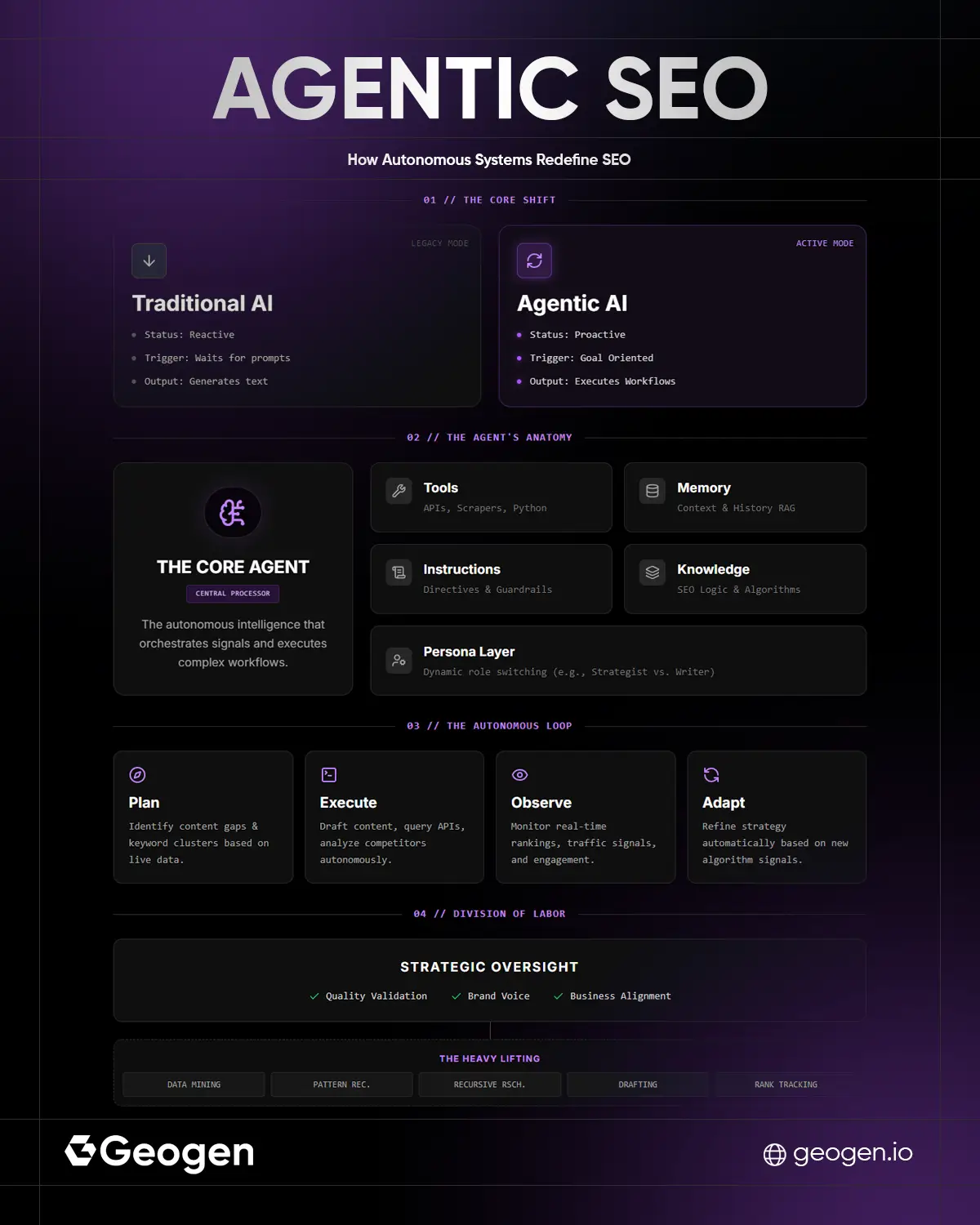
The best AI SEO tools fall into two groups: AI-powered SEO software, which uses AI to research, write, optimize and audit pages (Surfer, Frase, Semrush, Ahrefs, Screaming Frog), and AI visibility trackers, which measure whether ChatGPT, Gemini or Perplexity mention your brand (GeoGen, Otterly, Peec AI and others). Most teams need one of each.
The phrase “AI SEO tools” is used for both, which is why search results for it are confusing. This guide separates them, gives verified prices as of October 2026, and says which questions each type can and cannot answer. If you only want the trackers, our ranked list of AI visibility tools goes deeper.
What counts as an AI SEO tool?
An AI SEO tool is software that applies AI to search work, or measures AI-driven search. The split matters because you buy them for different jobs.
| Aspect | AI-powered SEO software | AI visibility trackers |
|---|---|---|
| Job | Do SEO tasks faster | Measure what AI engines say about you |
| Typical output | Briefs, optimized drafts, audits, keyword data | Mentions, citations, share of voice, sentiment |
| Examples | Surfer, Frase, Semrush, Ahrefs, Screaming Frog | GeoGen, Otterly.AI, Peec AI, Scrunch |
| Measures AI answers? | Only if it has an AI tracking module | Yes, that is the product |
| Writes content? | Often | Rarely; GeoGen does not |
A tool in the second column will not write your articles, and a content optimizer will not tell you if Perplexity cites a competitor instead of you. Buy for the gap you actually have.
Which AI-powered SEO software is worth using?
Prices below are from each vendor’s pricing page in October 2026.
| Tool | What it is for | Starting price | AI visibility module? |
|---|---|---|---|
| Surfer | Content optimization and briefs | EUR 49/mo Discovery (billed yearly) | Yes: AI Search Analytics EUR 82/mo, 50 prompts, plus tracking on higher plans |
| Frase | Briefs, optimization, AI visibility | $39/mo billed yearly ($49 monthly) | Yes: 50 prompts, ChatGPT and Google AI on Starter |
| Semrush | All-in-one SEO suite | AI Visibility Toolkit $99/mo; suite plans: see vendor site | Yes, as the toolkit |
| Ahrefs | Backlinks, keywords, audits | Lite $129/mo; Brand Radar from $199/mo | Yes, as Brand Radar |
| Screaming Frog SEO Spider | Technical crawling | Free up to 500 URLs; $279 per licence per year | No |
| Google Search Console / Bing Webmaster Tools | First-party search data | Free | Bing has an AI Performance report |
Content optimization: Surfer and Frase
Both score a draft against what already ranks and suggest terms and structure. They help most when you publish at volume and need consistent briefs. They do not decide what is true; every claim still needs your review, and our answer-first content guide shows the structure AI engines tend to lift.
Research and audits: Semrush and Ahrefs
These are the broad suites for keyword research, backlinks and site audits. Both now bolt AI tracking on: Semrush’s toolkit is $99 a month, and Ahrefs lists Brand Radar from $199 a month. Choose them if you already depend on their data and want AI tracking in the same login.
Technical: Screaming Frog and the free consoles
A crawler finds what blocks both Google and AI crawlers: broken links, noindex tags, thin pages. Combine it with Google Search Console, where AI Overviews and AI Mode traffic is reported inside the Web search type, and Bing Webmaster Tools, whose AI Performance report launched in February 2026 and shows Copilot citations. Our AI crawler guide covers the technical fixes.
Which AI visibility trackers belong in the stack?
These tools answer a question SEO suites traditionally could not: when someone asks an AI engine about your category, does it name you?
| Tool | Starting price (Oct 2026) | Notes |
|---|---|---|
| GeoGen | EUR 25/mo (EUR 20 yearly) | 15 engines, daily runs, actions plan; tracks and recommends, does not write content |
| Otterly.AI | $29/mo | ChatGPT, AI Overviews, Perplexity, Copilot |
| Rankscale | From $20/mo | Credit-based |
| AthenaHQ | Free tier; $295/mo Starter | Includes a content optimization agent |
| Peec AI | See vendor site | Prompt volume, API, MCP |
| Profound | Sales-led | Free 7-day trial available |
For GeoGen in particular, be clear about the limits: no free plan or trial, no Llama or Meta AI tracking, and query fan-outs for Grok and Perplexity only. Its benefit is that daily tracking, citations and competitor detection come on every plan, from EUR 25 a month. See the full side-by-side in best AI visibility tools.
How to choose between the two categories
- You publish a lot and quality is uneven: start with a content optimizer.
- You rank on Google but never appear in AI answers: start with a visibility tracker, then use the citation data to decide what to fix.
- You run an agency: you will likely want both, and per-client pricing matters more than the headline.
- You have almost no budget: Search Console, Bing Webmaster Tools, Screaming Frog free and a handful of manual prompt checks cover a surprising amount.
A starter AI SEO stack at three budgets
| Budget | Stack |
|---|---|
| Free | Google Search Console, Bing Webmaster Tools, Screaming Frog (500 URLs), manual prompt checks, AthenaHQ Essential |
| Around $50 a month | Add one entry-level tracker (GeoGen Micro, Otterly Lite or Rankscale) |
| Around $150 a month | Add Frase or Surfer for content, and a mid-tier tracker |
Whichever you pick, measure before and after: the point of any AI SEO tool is a change in a number you care about, not a longer tool list. Our GEO metrics guide lists which numbers to watch.
Frequently asked questions
What are AI SEO tools?
AI SEO tools are software that either use AI to speed up SEO tasks such as content briefs, optimization and audits, or measure how AI answer engines mention and cite your brand. The two categories solve different problems, and most teams end up using one from each.
Are AI SEO tools worth it?
They are worth it when they remove a bottleneck you can name, such as brief writing or tracking AI answers. They are not worth it if you buy them hoping for rankings on their own. Google states there are no special requirements to appear in AI Overviews beyond normal SEO.
Can AI tools replace an SEO professional?
No. AI tools draft, audit and monitor faster, but someone still has to decide what to publish, check facts, earn links and interpret data. Treat them as assistants for a strategist, not substitutes, especially for topics where accuracy and expertise matter.
What is the best free AI SEO tool?
Google Search Console and Bing Webmaster Tools are the best free starting points because they show real data, including Bing's AI Performance report for Copilot citations. Screaming Frog's SEO Spider is free up to 500 URLs, and AthenaHQ has a free tier for AI visibility tracking.
Do I need a separate tool to track ChatGPT visibility?
Yes, if you want it measured consistently. Classic SEO suites track Google rankings, and only some have added AI tracking. A dedicated visibility tracker runs the same prompts on a schedule across engines so you can see change over time instead of anecdotes.