Query Fan-Out Explained: How AI Search Breaks One Prompt Into Many
Query fan-out is how AI search splits one prompt into many searches. Learn how it works in ChatGPT, Perplexity and AI Mode, with examples and how to optimize.
Key takeaways
- Query fan-out is when an AI system splits one prompt into several related searches, runs them, and combines the results into one answer.
- Google confirms AI Mode and Deep Search use it; measured fan-out counts differ by engine and study, from about 1.4 to 6.8 per prompt in one April 2026 sample.
- Your page can be retrieved for sub-questions you never targeted, so cover the follow-up questions around a topic, not just the headline query.
- You can see fan-outs by logging them from AI engines that expose them; GeoGen records them today for Grok and Perplexity.
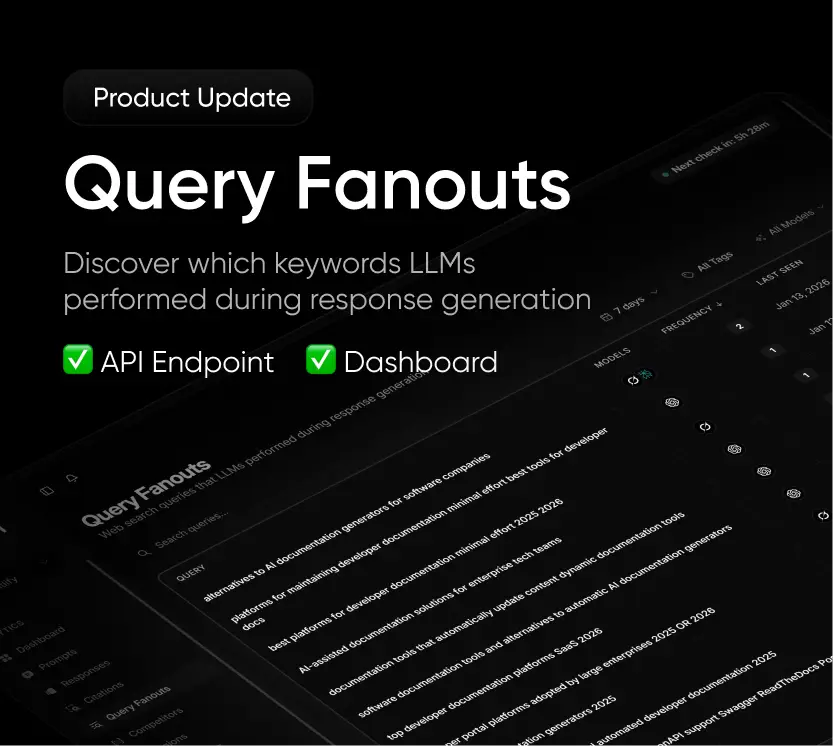
Query fan-out is when an AI search system breaks one prompt into several related searches, runs them, and combines what it finds into a single answer. Google describes it for AI Mode as breaking your question into subtopics and issuing a multitude of queries simultaneously. What you type is not what gets searched, and that changes which pages are retrieved.
If you create content, the practical meaning is simple: your page is competing for sub-questions you may never have targeted.
How does query fan-out work?
A fan-out has four steps.
- Interpret the prompt. The model works out what is being asked, what is missing and what would make a good answer.
- Generate sub-queries. It writes several search strings. They may cover different aspects, rephrase the question, add a comparison, or narrow to a specific year or location.
- Retrieve in parallel. Each sub-query runs against a search index or the web. Results come back as candidate pages and passages.
- Synthesize. The model selects passages across the results, resolves conflicts and writes one answer, usually with citations.
Google says Deep Search takes the same approach at larger scale and can issue hundreds of searches before producing a cited report.
What does a fan-out look like in practice?
The sub-queries below are an illustration of the pattern, not captured from one specific run.
Prompt: “What’s the best way to get my SaaS recommended by ChatGPT?”
| Sub-query (illustrative) | What it is trying to learn |
|---|---|
| how ChatGPT chooses sources to cite | Mechanism |
| improve brand visibility in ChatGPT answers | Tactics |
| ChatGPT search crawlers robots.txt OAI-SearchBot | Technical access |
| AI visibility tracking tools for SaaS | Tools |
| generative engine optimization checklist | Frameworks |
A page that only answers “best way to get recommended by ChatGPT” competes in one of five lanes. A site with strong pages for each lane is retrievable in all five.
Real sub-queries recorded by GeoGen
For GeoGen’s own tracked prompts about AI visibility tools, the Query Fanouts module recorded searches such as these in September 2026. They were logged from engines that expose their searches:
- “AI search visibility optimization platforms global markets reviews”
- “enterprise AI search optimization platforms”
- “top generative engine optimization platforms international markets”
- “AI-powered search engine optimization tools”
Notice what changed from a typical prompt. They are shorter, keyword-like and loaded with modifiers such as “global”, “enterprise” and “international”. They read like search strings rather than conversation, so the vocabulary differs from the prompts people type.
Which engines use query fan-out?
| Engine | What is known |
|---|---|
| Google AI Mode and Deep Search | Google states it uses query fan-out (Google) |
| Google AI Overviews | Google says AI Overviews and AI Mode may use a query fan-out technique, issuing multiple related searches |
| ChatGPT with search | Studies show it issues web searches for many prompts; counts vary by method |
| Perplexity | Issues sub-searches; one study put the average near 1.4 per prompt |
| Grok | One study measured the highest average of the three it tested |
On volume, Peec AI’s sample of 5 million fan-outs collected April 1 to 21, 2026 reported 1.4 fan-outs per prompt for Perplexity, 2.1 for ChatGPT and 6.8 for Grok. Other studies report very different averages because they count different things, such as all prompts versus only prompts that triggered search. Use any figure as a rough guide, and note that behavior changes as products update.
Why does query fan-out matter for content?
- Retrieval happens at sub-query level. You can be cited for a question you did not directly target.
- Topic coverage beats single-page targeting. A hub of connected pages can match several sub-queries in one answer.
- Passages are the unit. A clear section answering one sub-question is easier to pull than a vague page.
- Rankings alone are a poor proxy. You may not rank for the prompt but still be retrieved for a sub-query. Citation tracking shows this; rank tracking does not.
- Standard SEO still gates it. For Google’s AI features, pages need to be indexed and eligible to show with a snippet, and Google says no additional special optimizations are required.
How do you find fan-out queries for your topic?
- Log them from engines that expose them. Some AI products show the searches they ran. Record them for your priority prompts.
- Use a tracker. GeoGen’s Query Fanouts module records the searches AI engines run while answering your tracked prompts, currently for Grok and Perplexity. Treat those as a sample of how engines break down your topic.
- Simulate by hand. List the sub-questions a careful buyer would ask: definition, how it works, cost, alternatives, risks, how to start, how to measure. That list approximates what a model would generate.
- Mine your support and sales data for follow-up questions.
- Cluster the result into themes. Each theme is a candidate section or page.
How do you optimize for query fan-out?
- Map the question space. For each core topic, write the 10 to 20 sub-questions around it.
- Cover each with a self-contained section. Question heading, direct answer first. See the answer-first strategy.
- Split pages by intent, link them as a cluster. One page per major sub-intent, with descriptive internal links between them.
- Match the vocabulary. If fan-outs use “enterprise”, “international” or “pricing”, make sure pages that deserve those modifiers state them plainly.
- Keep facts current. Sub-queries can add qualifiers such as a date or a recent event. Show visible dates and update dates.
- Structure for extraction. Headings, tables and short chunks help. See content structure for AI visibility.
- Make sure it is crawlable. If bots cannot fetch the page, none of this counts. See how to optimize for AI crawlers.
- Measure citations. Track the same prompts over time and watch which pages get cited.
How is fan-out related to semantic search?
Each sub-query is matched to passages by meaning, as explained in AI semantic search. Fan-out decides what gets searched; semantic retrieval decides what comes back.
What should you do first?
Take your single most valuable prompt. Write out the sub-questions behind it. Check, for each, whether you have a section or page that answers it directly in its first sentence. Fill the gaps in order of business value, then watch whether citations for the original prompt improve. GeoGen tracks those prompts daily across 15 engines, and the GEO audit tool is a starting point for reviewing a site.
Frequently asked questions
What is query fan-out?
Query fan-out is a technique where an AI search system breaks a user's prompt into multiple related sub-queries, runs them in parallel or in sequence, and merges the retrieved results into one answer. Google describes AI Mode as breaking a question into subtopics and issuing a multitude of queries at once.
Which AI engines use query fan-out?
Google says AI Mode, AI Overviews and Deep Search use it. ChatGPT with search and Perplexity also issue multiple web searches for many prompts, as measured by third-party studies. Exact behavior, and how many searches run, differs by engine and changes over time.
How many queries does a prompt fan out into?
It varies widely. In one April 2026 sample of 5 million fan-outs, Peec AI reported averages of 1.4 per prompt for Perplexity, 2.1 for ChatGPT and 6.8 for Grok. Other studies report different numbers because they count different things, so treat any single figure as indicative.
How do I find the fan-out queries for my topic?
Run your prompts in an AI engine that exposes its searches and record them, or use a tracker that logs them. GeoGen records query fan-outs for Grok and Perplexity. You can also approximate by listing the follow-up questions a buyer would ask about your topic.
Does query fan-out change how I should write content?
Yes, in emphasis. Because a single prompt triggers several searches, a page that answers the main question and the likely sub-questions in self-contained sections has more chances to be retrieved. Question headings and complete coverage of a topic help.
Is query fan-out the same as related searches or People Also Ask?
No, though they overlap in spirit. Related searches and People Also Ask are suggestions shown to users, while fan-out queries are generated by the AI system itself, often as search strings written for retrieval, and can differ from anything a person would type.