How to Sell GEO Services: A Playbook for Agencies
How to sell GEO services to clients: package an audit, run a 30-day pilot, report monthly, handle objections and scope a retainer. A playbook for agencies.
Key takeaways
- Sell GEO as a measured add-on to an existing SEO retainer, starting with a paid baseline audit rather than a full retainer pitch.
- A 30-day pilot on 20 to 30 prompts gives the client proof before they commit to monthly spend.
- Report visibility, citations, sentiment and competitor gaps monthly, and never promise a specific placement in an AI answer.
- Price the retainer on scope (prompts, brands, content and PR deliverables), not on hours, and keep tooling cost per client visible to yourself.
To sell GEO services, lead with evidence instead of theory: run the client’s own buying prompts through AI engines, show where competitors are named and they are not, then convert that gap into a paid audit, a 30-day pilot and a monthly retainer. Clients buy the screenshot and the trend line, not the acronym.
This playbook covers the offer ladder, the pilot, the reporting cadence, objection handling and a sample retainer scope. For how to set the fee, see the GEO pricing guide. For the tooling side, see the best AI visibility tools for agencies.
What exactly are you selling when you sell GEO?
GEO (generative engine optimization) is the work of getting a brand mentioned and cited accurately in answers from ChatGPT, Gemini, Perplexity and Google AI Overviews. In agency terms it is three deliverables: measurement (are we named?), fixes (content, structure, third-party sources) and reporting (is it moving?).
Keep the offer concrete. “AI visibility” is the buyer-facing phrase; “GEO” is the practitioner term. Use whichever the client already says. If your team needs a shared definition first, point them to what is generative engine optimization.
How should you package GEO for clients?
Use a three-step ladder so no client has to make a big decision on day one.
| Step | What the client buys | Typical duration | Your output |
|---|---|---|---|
| 1. Baseline audit | A one-off measurement of AI visibility | 1 to 2 weeks | Prompt set, visibility vs competitors, top citation sources, fix list |
| 2. Pilot | A defined set of fixes plus tracking | 30 days | Day-1 and day-30 comparison, what moved and why |
| 3. Retainer | Ongoing tracking, content and source work | Monthly, 3-month minimum | Monthly report, shipped actions, next priorities |
The audit is the sale. Everything after it is easier because the client has seen their own data. Price the audit so it is not free (a free audit signals low value) and credit it against the first retainer month.
How do you build a baseline audit that closes?
- Pick 30 to 50 prompts the client’s customers actually ask. Mix category questions (“best X for Y”), comparison questions and problem questions. Include brand-name prompts to catch inaccurate answers.
- Run them across the engines that matter for that client. GeoGen reads ChatGPT, Google AI Overviews, Google AI Mode, Gemini, Perplexity and Microsoft Copilot as a user sees them, and queries seven more models directly, 15 in total.
- Record four things: how often the brand is mentioned, in what position, with what sentiment, and which domains the answer cites.
- Name the three biggest gaps. Usually a competitor owns a prompt cluster, a review site or forum is the main cited source, or the AI states something wrong about the client.
- Put one concrete answer on a slide. A real answer that names the competitor and omits the client does more than any statistic.
How do you run a 30-day GEO pilot?
A pilot removes the commitment risk that stalls most GEO deals.
- Week 0: agree the prompt set (20 to 30), three to five competitors and the success measure (for example, visibility on a named prompt cluster).
- Week 1: record the baseline and ship the highest-impact fixes: answer-first rewrites of key pages, structured data, fixes to wrong brand facts on owned pages.
- Weeks 2 to 3: work the off-site side: the third-party sources AI engines already cite for the cluster.
- Week 4: re-run the prompts and report the change, including what did not move.
Because engines return different answers on different runs, judge the pilot on a trend across many prompts and several days, not on one answer. GeoGen runs every prompt daily, which makes the day-30 comparison a trend rather than a snapshot.
What reporting cadence keeps clients paying?
Monthly is the working rhythm: weekly is noise, quarterly is too slow to show progress. A one-page monthly report should hold:
| Section | Content |
|---|---|
| Headline | Visibility change vs last month, in one sentence |
| Visibility and position | Share of tracked answers that mention the brand, average position |
| Sentiment | Score movement and any negative themes |
| Citations | Domains the AI cites, new and lost sources |
| Competitors | Who gained or lost on the tracked prompts |
| Actions | What shipped, what is next |
If you present the dashboard under your own brand, check what your vendor supports. GeoGen lets agencies present the dashboard with their own logo; confirm other branding specifics with the team before promising them. The white-label GEO explainer lists the questions to ask any vendor.
How do you handle the common objections?
| Objection | Response |
|---|---|
| “Isn’t this just SEO?” | It builds on SEO, but the result is measured as inclusion in a generated answer. Show one answer where the client is missing. |
| “How many people actually use AI search?” | Do not argue market share. Show how many of the client’s own buying prompts already return a competitor. |
| “Can you guarantee a mention?” | No one can. You guarantee the process, the measurement and the reporting. |
| “We have no budget.” | Offer the audit alone, or fund the pilot by reallocating a slice of an existing content or SEO retainer. |
| “Can’t we just do this in ChatGPT ourselves?” | Single manual checks are not repeatable. Answers vary by run, engine and location, so a report needs daily, multi-engine data. |
| “What if the results are flat?” | Agree success measures up front, and report flat results honestly with a changed plan. |
What does a sample GEO retainer scope look like?
The table below is an illustrative structure, not a market benchmark. Adjust prompts, brands and deliverables to the client; the fee logic is in the pricing guide.
| Scope item | Starter | Growth | Scale |
|---|---|---|---|
| Brands tracked | 1 | 1 to 2 | 3 or more |
| Tracked prompts | 30 to 50 | 100 to 150 | 300 or more |
| Engines | 4 | 6 or more | 7 or more |
| Monthly report | One page | One page plus review call | Report plus executive review |
| Content work | 2 page updates | 4 page updates or 2 new pages | Content sprint each month |
| Off-site source work | Recommendations only | 2 placements or outreach targets | Ongoing digital PR |
| Wrong-fact and sentiment fixes | Flagged | Fixed on owned pages | Fixed plus third-party corrections |
Always write the tooling cost per client into your internal model. On GeoGen’s Pro plan billed yearly, 15 brands cost €399 a month, about €26.60 per brand per month; the arithmetic is in the pricing guide.
How do you add GEO to an existing SEO retainer?
Do not create a second contract. Add a GEO line item: a measurement block (tracking and report) plus a fixed number of optimization actions per month. Reuse your existing content and technical workflow. Most GEO fixes are page rewrites, structured data and source outreach your team already does.
Position it as protecting the work the client already pays for. If a competitor is recommended instead of the client, the organic traffic you build is only half the funnel.
What mistakes lose GEO deals?
- Selling a guarantee. Engines are probabilistic and you do not control them.
- Showing a dashboard without a story. Lead with the gap and the action, not the metric list.
- Reporting a single run. Show trends across prompts and days.
- Underpricing because the tool is cheap. The tool is the measurement; the fee pays for the fixes and the expertise.
- Starting without a baseline. No day-1 number means no proof at day 30.
Frequently asked questions
How do I sell GEO services to existing SEO clients?
Offer a paid baseline audit first. Run 30 to 50 of the client's real buying prompts across the main AI engines, show how often the brand is mentioned versus competitors, then propose a pilot. Existing clients already trust you, so the audit is an upsell, not a cold pitch.
How do I pilot GEO with a client?
Agree on 20 to 30 prompts, three to five competitors and a 30-day window. Record the baseline on day one, ship a defined set of fixes, and compare visibility at day 30. Keep the pilot fee small and credit it against the first retainer month.
Can I guarantee a client will be mentioned in ChatGPT?
No. AI answers vary from run to run, and no vendor controls them. Promise a process and a measured trend: a baseline, a defined set of fixes, and monthly reporting on visibility, citations and sentiment. Avoid any contract wording tied to a specific placement.
What should a monthly GEO report contain?
Visibility (share of tracked answers that mention the brand), average position, sentiment, the citations that feed the answers, competitor movement, and the actions completed. Close with the next month's priorities. Keep it to one page for executives and an appendix for the detail.
What do I do when a client says GEO is just SEO?
Agree partly. GEO builds on SEO, but the output is measured differently: inclusion in a generated answer, not a blue-link rank. Show them one answer where a competitor is named and they are not. That single screenshot usually ends the debate.
Do I need a tool to sell GEO?
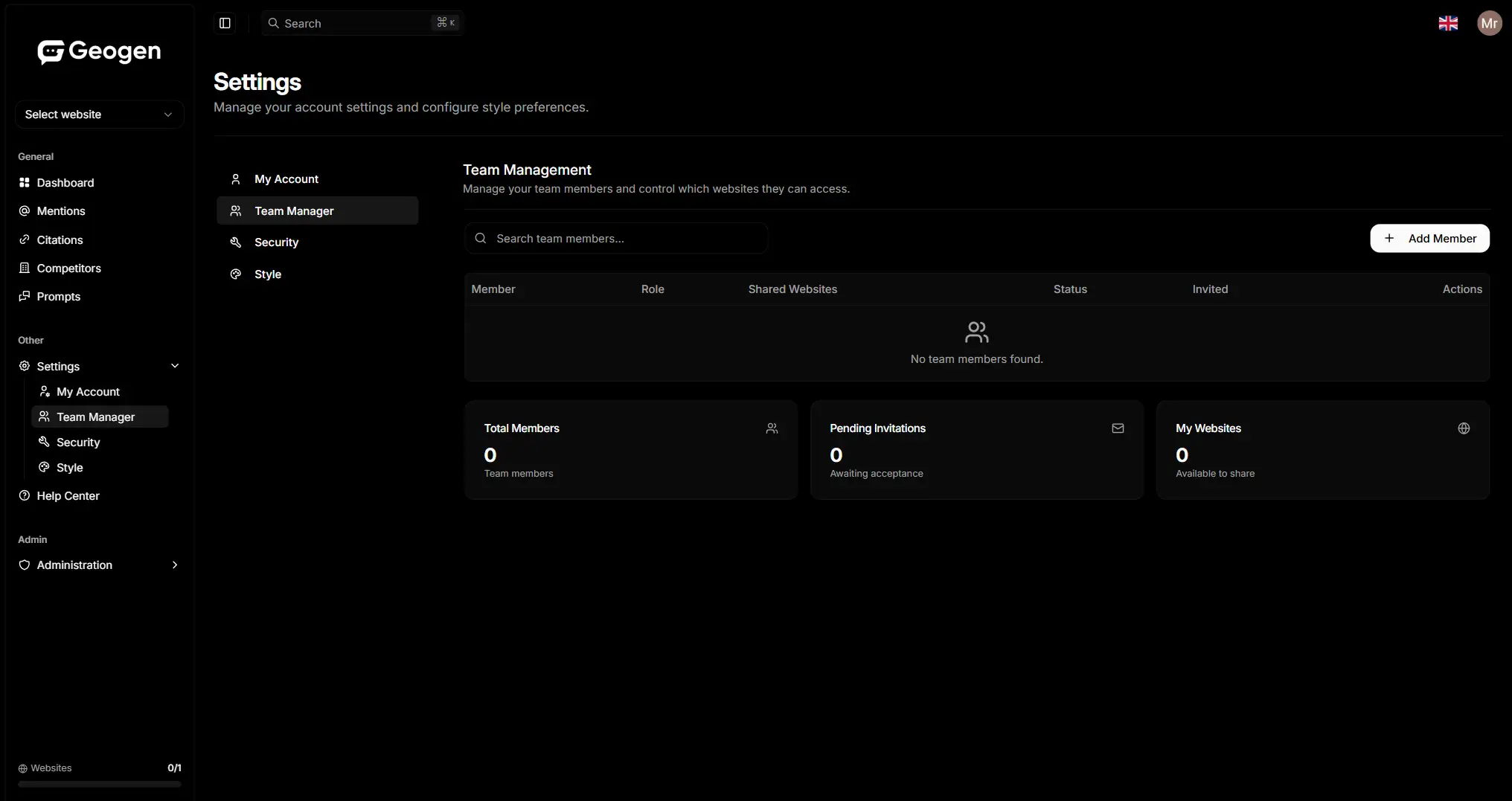
Yes in practice. AI answers change daily and differ per engine, so manual spot checks cannot support a report or a retainer. A tracking platform with multi-client workspaces makes the baseline, the pilot and the monthly report repeatable.